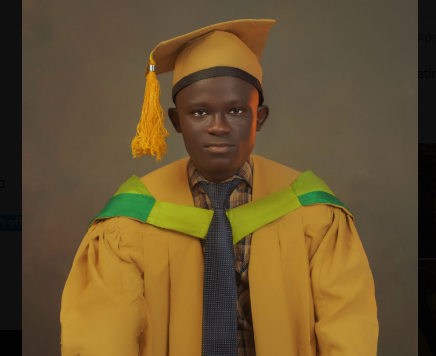
Oladepo Caleb Olugbenga, who spent nine years growing up without electricity in a village in Osun State, has emerged as the overall best graduating engineering student of Ladoke Akintola University of Technology (LAUTECH) with a cumulative grade point average of 4.89 out of 5.0.
Oladepo, a graduate of Electronic and Electrical Engineering in the university’s 2024/2025 academic session, said his early life was marked by severe financial hardship. He attended public primary and secondary schools because private education was unaffordable, often walking long distances to school while his parents worked multiple jobs to support the family.
He recalled that his household lacked electricity and a television for nearly a decade before he entered university, relying instead on lanterns and candles for study. Food, clothing and school fees, he said, were daily challenges.
Following his convocation recognition on January 14 as the institution’s overall best engineering graduate, Oladepo publicly acknowledged support from the Nigerian Education Loan Fund (NELFUND), stating that the student loan scheme played a key role in his academic journey.
“I’m honoured to let you know that I am the Best Graduating Student of LAUTECH. Your loans made it possible,” he wrote in a post on X, drawing widespread reactions from supporters and critics alike.
While many praised both his academic achievement and his acknowledgement of the student loan programme, others argued that his comment unnecessarily linked personal success to a government initiative. Some commentators also urged NELFUND to consider waiving his loan in recognition of his performance.
NELFUND responded by congratulating him, describing his achievement as evidence of the programme’s intended impact in supporting students from financially constrained backgrounds.
In a follow-up statement on Friday, Oladepo clarified his position, explaining that his appreciation of the scheme reflected his personal experience rather than political motivation.
“I hail from a village in Osun State, raised in a modest family of five,” he said. “Even the most inexpensive private schools were beyond our means.”
He added that survival itself—including access to food and clothing—was often difficult during his early years. He also recalled receiving support at different stages of his education, including a scholarship and assistance from lecturers, as well as a smartphone gifted by a coursemate’s father whom he had previously tutored.
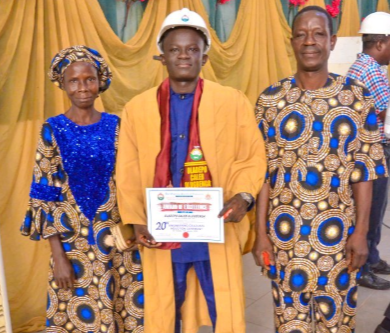
“For me personally, NELFUND was not incidental; it was instrumental,” he said, stressing that acknowledging support received along the way was simply an act of gratitude rather than propaganda.
Special Adviser to President Bola Ahmed Tinubu on Information and Strategy, Bayo Onanuga, described the graduate’s story as reflecting the policy intent behind the student loan initiative, which was designed to support learners who might otherwise be unable to access tertiary education.
Earlier, LAUTECH Vice-Chancellor Razaq Kalilu disclosed that more than ₦1.4 billion in NELFUND loans had been disbursed to students of the institution in 2025, although thousands of approved applicants were still awaiting full payment around the time of the convocation.
NELFUND was established to administer the Nigeria Student Loan Scheme signed into law by President Tinubu in April 2024. The programme provides interest-free loans to students in public tertiary institutions to cover tuition and living expenses, with repayment expected after graduation and employment.
As of March 2026, the fund reported that over 1.1 million students had benefited from more than ₦206 billion disbursed nationwide, while urging institutions to remain flexible with registration deadlines for applicants whose payments were still being processed.