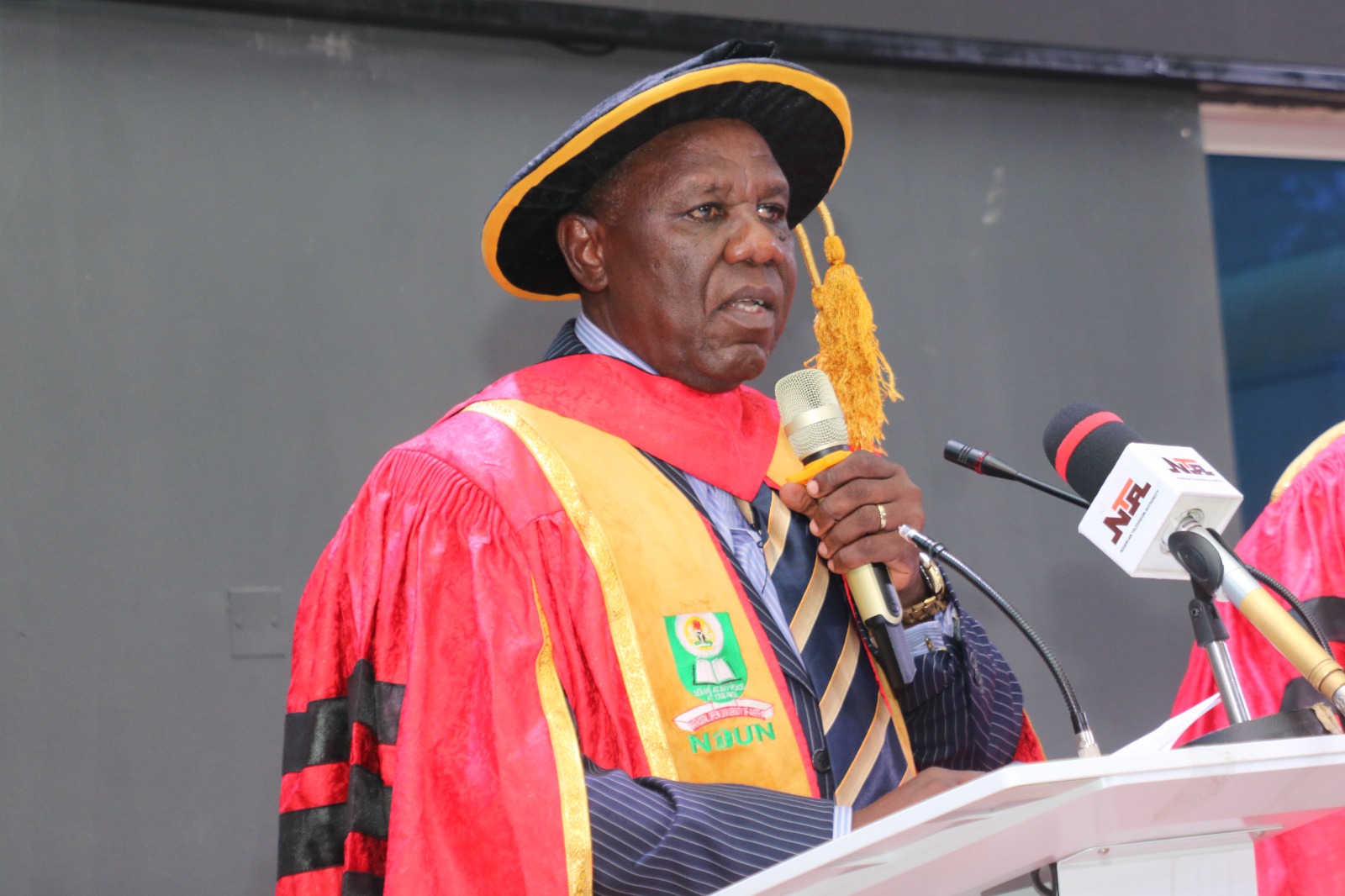

A Professor of Banking and Finance, Wilfred Ugwuanyi, has said Nigeria’s long-term economic stability depends on building a financial system that reflects the country’s cultural diversity while remaining inclusive and efficient.
Ugwuanyi made the call on Thursday while delivering the 39th inaugural lecture at the National Open University of Nigeria (NOUN) headquarters in Abuja.
According to a statement issued on Friday by the institution’s Director of Media and Publicity, Ibrahim Sheme, the lecture focused on the relationship between technological innovation and informal financial practices within Nigeria’s diverse social environment.
The professor noted that informal financial systems continue to play a critical role in supporting millions of Nigerians, especially in rural areas where access to formal banking services remains limited.
He described these systems as the “backbone of financial survival,” stressing that they go beyond simple transactions to provide social and economic stability.
In his lecture titled “Technological Innovations and Informal Financial Institutions: Implications for Economic Development Amidst Cultural Diversity in Nigeria,” Ugwuanyi traced the evolution of financial systems from barter trade to modern banking structures introduced during the colonial era.
He explained that innovations such as mobile money, ATM services, and digital banking have significantly expanded financial inclusion, particularly in urban areas and among previously underserved populations.
However, he warned that access to digital financial tools remains uneven due to infrastructure gaps, low internet penetration in rural communities, digital illiteracy, and growing cybersecurity concerns.
Ugwuanyi also highlighted persistent distrust among some Nigerians toward formal banking systems and digital financial platforms, which he said continues to limit adoption.
A key focus of his lecture was the continued relevance of informal financial institutions such as thrift collectors, cooperative societies, and community-based savings groups, which he said are built on trust and shared identity.
“These systems are not merely financial mechanisms but social institutions grounded in trust, mutual support and shared identity,” he said.
He added that social capital within communities often serves as an informal guarantee system, helping to sustain financial resilience where formal institutions may be less effective.
While acknowledging the benefits of financial technology, Ugwuanyi cautioned that poorly designed fintech solutions could exclude the very groups they aim to support.
He called for policies that balance innovation with consumer protection and urged policymakers to integrate informal financial structures into the broader financial system rather than attempt to replace them.
According to him, Nigeria’s cultural diversity should be seen as a strength in designing financial policies, warning that a uniform approach to financial inclusion would likely fail.
Ugwuanyi also advocated for improved financial literacy programmes tailored to Nigeria’s linguistic and cultural differences, alongside stronger collaboration among stakeholders.
Speaking at the event, the Vice-Chancellor of NOUN described inaugural lectures as a platform for intellectual engagement and policy-relevant discourse.
He noted that many NOUN students already rely on informal financial systems in their daily lives, adding that the university continues to use technology to expand access to education nationwide.
Nigeria’s financial ecosystem currently operates a dual structure, where rapid fintech growth coexists with deeply rooted informal systems, particularly in rural and peri-urban communities where many citizens remain unbanked or underbanked.