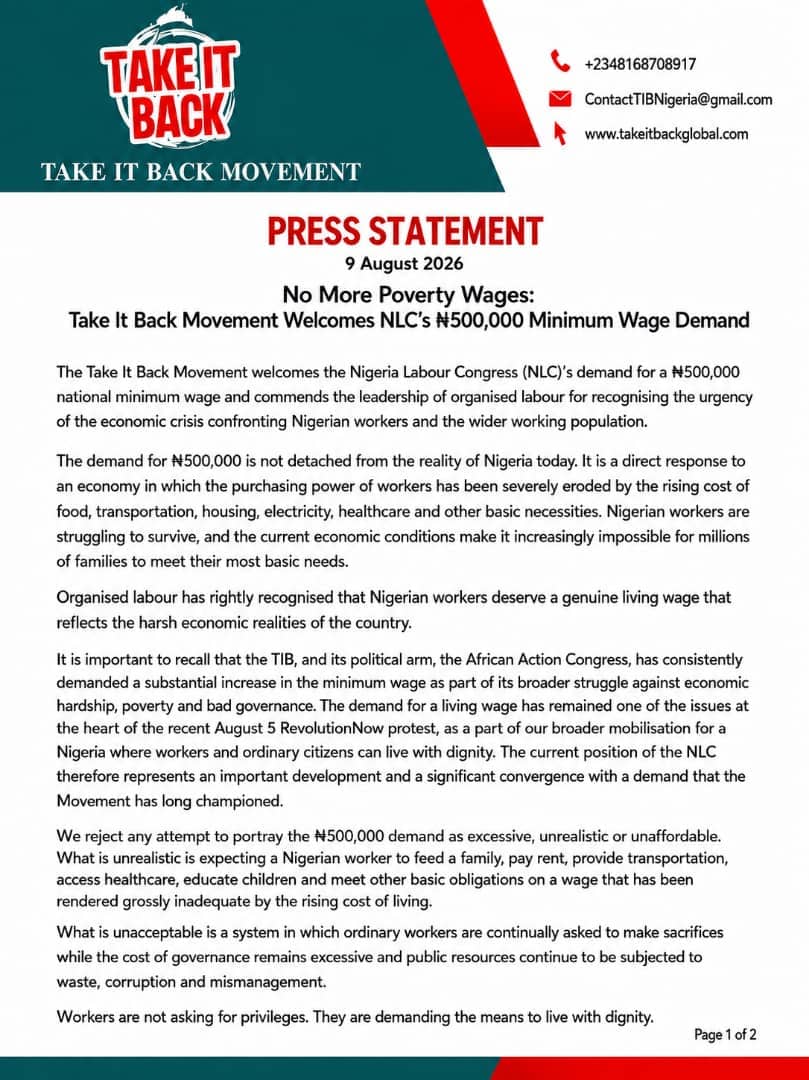
The Take It Back Movement (TIB) has backed the Nigeria Labour Congress (NLC)’s demand for a ₦500,000 national minimum wage, describing it as a necessary response to the rising cost of living and worsening economic hardship facing Nigerian workers.

In a statement signed by its National Coordinator, Sanyaolu Juwon, on Sunday, the movement said the demand reflected the realities of the current economic situation, where rising costs of food, transportation, housing, electricity and healthcare have eroded workers’ purchasing power.
TIB said Nigerian workers deserved a living wage capable of meeting basic needs and rejected arguments that a ₦500,000 minimum wage was excessive or unaffordable.
The movement linked the demand to issues raised
during its August 5 “Festival of the Oppressed” mobilisation, which it said focused on broader concerns including poverty, unemployment, insecurity, economic exploitation and poor governance.
According to the statement, TIB has consistently advocated substantial increases in workers’ wages as part of its campaign for economic justice and improved living conditions.
The group called on the Federal Government to treat the NLC’s demand seriously and avoid delays, token measures or attempts to divide organised labour.
“Workers are not asking for privileges. They are demanding the means to live with dignity,” the statement said.
TIB also pledged its support for the NLC, Trade Union Congress (TUC) and Nigerian workers in lawful and democratic efforts to secure better wages and living conditions.
The group called on the Federal Government to treat the NLC’s demand seriously and avoid delays, token measures or attempts to divide organised labour.
“Workers are not asking for privileges. They are demanding the means to live with dignity,” the statement said.
TIB also pledged its support for the NLC, Trade Union Congress (TUC) and Nigerian workers in lawful and democratic efforts to secure better wages and living conditions.
The movement maintained that workers’ wages should reflect their contribution to the nation’s economic wealth, declaring that the dignity of Nigerian workers was “non-negotiable.”