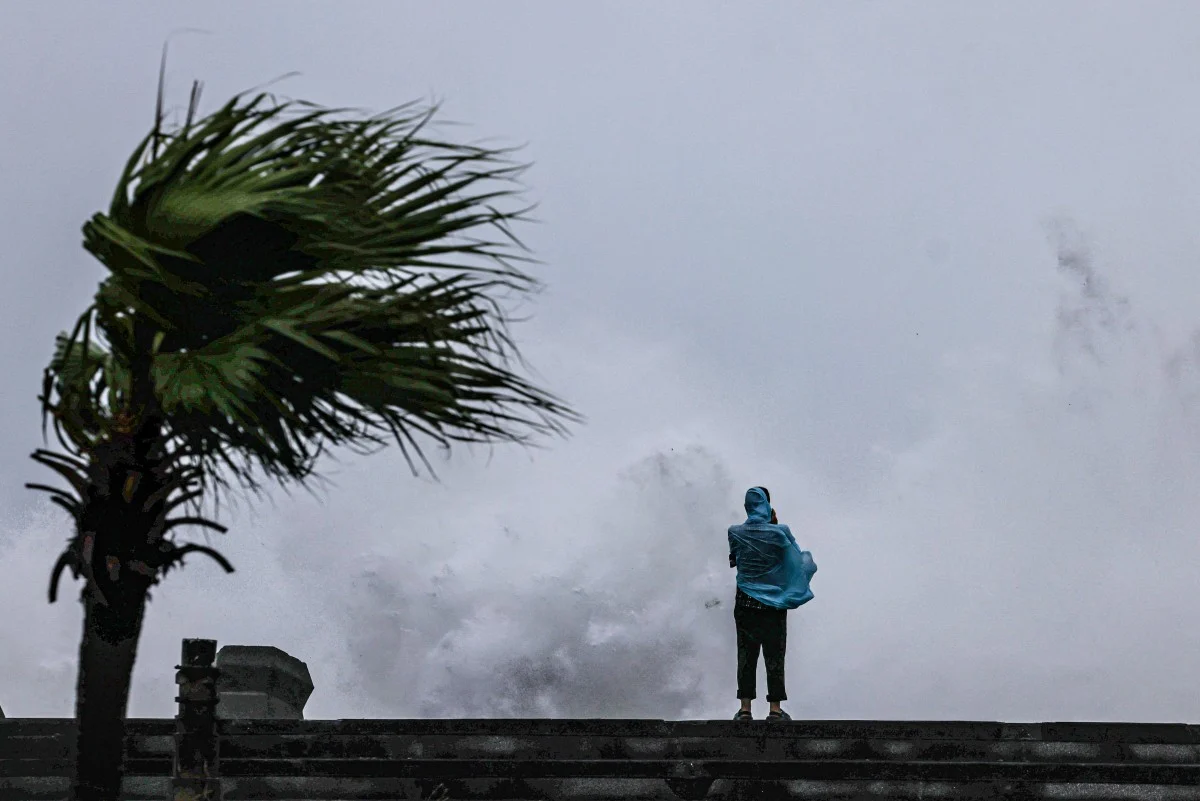
Typhoon Bavi made landfall in eastern China’s Zhejiang province late Saturday, bringing winds of up to 144 km/h after authorities evacuated nearly 1.72 million people ahead of the storm, according to state media.
The typhoon came ashore in Yuhuan City at about 11:20 p.m. local time and is expected to move northwest while gradually weakening. As of Saturday night, there were no immediate reports of casualties or major damage following its landfall.
Ahead of the storm, authorities suspended schools, businesses, public transport and outdoor activities across parts of Zhejiang. More than 400 flights and dozens of train services were also cancelled as emergency measures were put in place.
Local officials said the large-scale evacuations and safety restrictions were aimed at preventing loss of life. “The proactive, all-out mobilisation… is undertaken entirely to guard against the worst-case scenario,” the Wenzhou municipal government said.
Before reaching mainland China, Bavi battered northern Taiwan and Japan’s southwestern islands, toppling trees, disrupting transport and leaving tens of thousands of homes without electricity. In Taiwan, more than 14,000 residents were evacuated, hundreds of flights were cancelled and over 170,000 households experienced power outages.
The storm also prompted the evacuation of more than 100,000 people in Beijing due to flooding concerns, while more than 130,000 residents were relocated in Fujian Province and about 34,000 others from vulnerable coastal areas in Shanghai.
In the Philippines, the death toll linked to heavy rains triggered by the typhoon rose to 18, with landslides and flooding causing widespread damage. Nearly 11,000 people were displaced, while dozens of ports remained closed.
Meteorologists noted that warmer ocean temperatures and the return of the El Niño weather pattern have contributed to stronger tropical storms across the region. China has already experienced severe flooding this week, with storms reportedly claiming at least 39 lives and causing rivers to overflow and a reservoir dam to burst.
Typhoon Bavi, which weakened from a super typhoon after crossing the Pacific, remains one of the largest storms to affect East Asia this year, prompting widespread emergency responses across several countries.