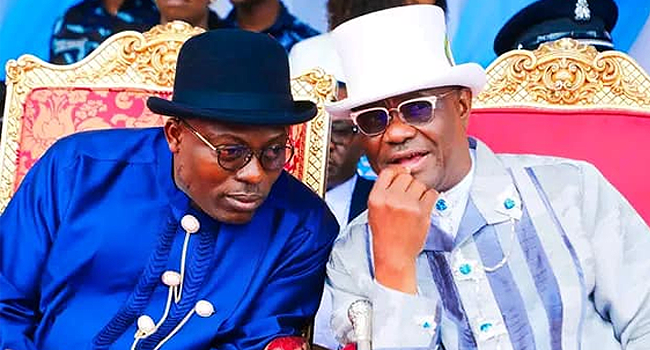
The political atmosphere in Rivers State remains tense and uncertain as unresolved tensions between Governor Siminalayi Fubara and the Minister of the Federal Capital Territory, Nyesom Wike, continue to influence the state’s political direction ahead of the 2027 elections.
Although both political figures were previously involved in a high-profile reconciliation process brokered by President Bola Tinubu, the underlying distrust between their camps persists, with recent political signals suggesting that the calm in the state may be superficial.
Wike’s repeated remarks that the “mistake of 2023 will not be repeated in 2027” have further fuelled speculation about his political alignment and his influence over succession plans in the oil-rich state. Meanwhile, discussions around possible governorship contenders continue to unfold quietly within party circles.
Within the Peoples Democratic Party (PDP), speculation has grown around possible successors, including Kingsley Chinda, the Minority Leader of the House of Representatives, who is reportedly favoured by some political interests linked to Wike. Other names, including Chief Boma Iyaye and Marcus Nle-Eji, have also surfaced in succession discussions, though none has formally declared ambition.
Governor Fubara, on his part, is yet to fully consolidate his political base within the All Progressives Congress (APC), where he is said to have limited integration compared to other governors who have aligned with the ruling party.
The emergence of rival APC factions in Rivers State and the continued dominance of loyalists aligned with Wike have further complicated the governor’s political standing, particularly as preparations for 2027 gradually gather momentum.
President Bola Tinubu’s recent directive, which emphasises governors as central figures in the political structure of their states, has added a new dimension to the crisis. While some view it as strengthening Fubara’s authority, others argue that entrenched political interests in Rivers may limit its practical impact.
The directive has sparked mixed reactions among political stakeholders, with some arguing that governors traditionally control party structures at the state level, while others insist that influential political actors and “godfathers” continue to shape outcomes behind the scenes.
The relationship between the Rivers State House of Assembly and the governor remains strained, despite federal intervention aimed at stabilising the political environment. Lawmakers have reportedly met only a few times in 2026, with lingering divisions still evident since the end of the emergency rule in the state.
Analysts say the continued friction between both arms of government could affect governance and political stability, especially as realignments begin ahead of the next election cycle.
While some political actors insist that peace has returned to the state following reconciliation efforts, others maintain that underlying tensions remain unresolved, with competing interests still influencing decision-making processes.
Observers say the evolving situation in Rivers State reflects a broader struggle for political control, with alliances, party structures, and federal influence all playing key roles in shaping the outcome of the 2027 governorship race.