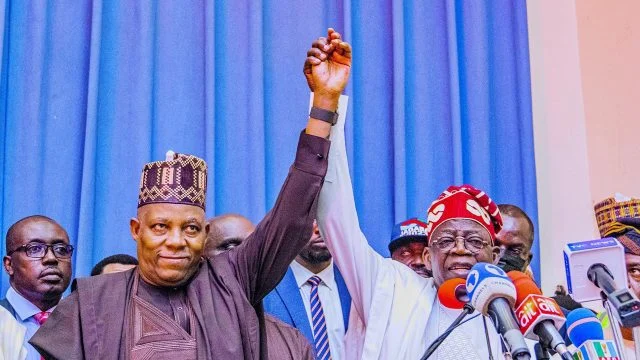
President Bola Tinubu’s decision to retain Vice President Kashim Shettima as his running mate for the 2027 presidential election has reignited debate over the All Progressives Congress (APC)’s Muslim-Muslim ticket, with political parties and stakeholders divided over whether competence or religious balance should determine leadership choices.
The APC’s confirmation ends months of speculation that Tinubu might replace Shettima with a Northern Christian and revives arguments that dominated the build-up to the 2023 general election. Despite criticism of the same-faith ticket at the time, Tinubu and Shettima went on to win the presidency.
The announcement has drawn mixed reactions. The All Progressives Grand Alliance (APGA) and the Young Progressives Party (YPP) argued that competence, integrity and leadership capacity should take precedence over religious identity. APGA spokesman Ejimofor Opara said Nigerians should judge leaders by their performance rather than their faith, while YPP spokesman Wale Egbeola-Martins described poor leadership—not religion—as the country’s greatest challenge.
Defending the decision, APC Director of Publicity Bala Ibrahim said the party carefully assessed the political landscape before retaining Shettima. He argued that fears of religious tension raised ahead of the 2023 election had not materialised and maintained that the Tinubu administration had promoted interfaith harmony.
Other political figures, including Action Democratic Party National Chairman Yabagi Yusuf and Coalition of United Political Parties leader Mark Adebayo, said the 2027 election is more likely to be shaped by issues such as security, the economy and the government’s performance than by religious considerations. Yusuf described the APC’s decision as a strategic political calculation aimed at maximising electoral support.
The Ijaw Youths Council also dismissed religion as the key factor in leadership selection. Its president, Jonathan Lokpobiri, said Nigerians should focus on electing leaders capable of addressing the country’s pressing challenges through effective governance.
However, several groups criticized the APC’s decision. The Coalition of South East Youth Leaders and the South-South Youths Initiative described the retention of the Muslim-Muslim ticket as insensitive to Nigeria’s religious diversity, arguing that the party missed an opportunity to promote inclusiveness by selecting a Northern Christian.
The Middle Belt Forum also opposed the decision, with its president, Dr. Pogu Bitrus, saying another same-faith ticket could deepen feelings of exclusion among Christians. In contrast, the Centre for Accountability and Open Leadership noted that the concerns raised before the 2023 election had largely failed to materialize, adding that Shettima’s loyalty and working relationship with the President may have influenced Tinubu’s decision.
Within the APC, stakeholders in Abia State welcomed Shettima’s renomination, describing it as a logical move given the administration’s stability. Ohanaeze chieftain Justice Rowland Ajuzieogu and industrialist Sam Ohuabunwa also backed the decision, citing Shettima’s loyalty and the ticket’s previous electoral success.
A faction of the pan-Yoruba socio-political group Afenifere, however, faulted the move. Its National Publicity Secretary, Justice Faloye, argued that retaining another Muslim-Muslim ticket failed to reflect fairness, religious balance and inclusiveness in a multi-faith nation.