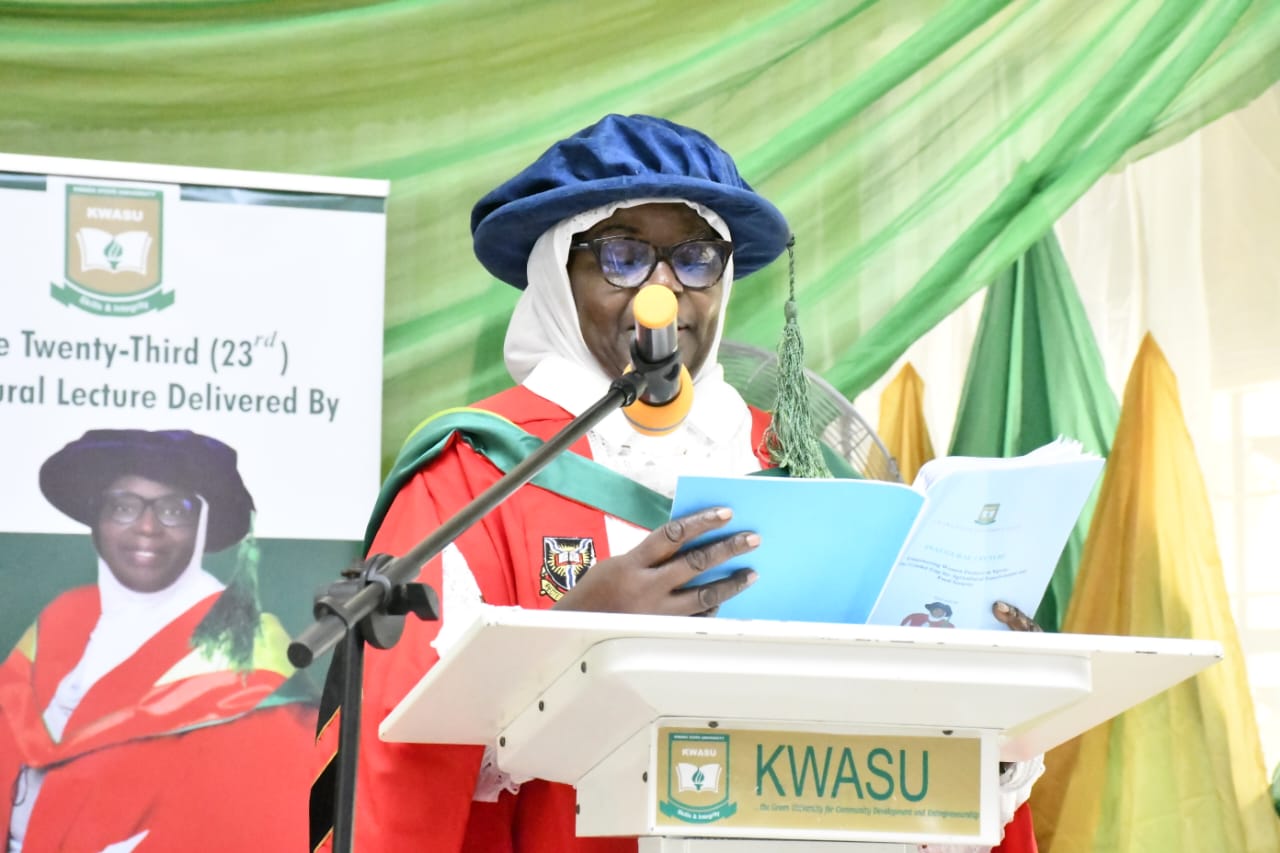
A Professor of Agricultural Economics at Kwara State University (KWASU), Malete, Professor Taibat Moji Yusuf, has called for sweeping reforms to remove the structural barriers limiting women’s participation in Nigeria’s agricultural sector.
Professor Yusuf made the call on Wednesday, September 2, 2026, while delivering the 23rd Inaugural Lecture of the institution titled, “Empowering Women Farmers in Nigeria: Closing the Gender Gap for Agricultural Transformation and Food Security.”
Drawing on more than three decades of field-based research, the inaugural lecturer said empowering women farmers was critical to improving agricultural productivity, strengthening food security, and reducing poverty across the country.
She urged the government to reform inheritance laws to guarantee women’s rights to own and inherit land regardless of their marital status while also promoting joint land ownership for married couples.
According to her, discriminatory land ownership practices remain one of the major obstacles preventing women farmers from accessing credit, agricultural inputs, and other productive resources.
She also advocated the expansion of gender-inclusive agricultural financing through microcredit schemes that do not require land as collateral.
Professor Yusuf said financial institutions should develop agricultural loan products tailored to the realities of women farmers and expand digital financial services to reach women in remote rural communities.
The professor further called for reforms in agricultural extension services, including the recruitment of more female extension agents, flexible training schedules that take account of women’s domestic responsibilities and the use of mobile platforms to provide agricultural advisory services in local languages.
She added that investments in rural water supply, electricity, and childcare infrastructure would help reduce the burden of unpaid domestic labour on women and free more time for farming and agribusiness.
She also recommended increased access to mechanised processing equipment and other labour-saving technologies designed around the operational needs of women farmers.
She stressed the importance of adult literacy, agricultural training, and cooperative organisations in improving women’s management skills, technology adoption, and bargaining power.
The inaugural lecturer called for policies that would support income diversification through off-farm employment, agro-processing, and entrepreneurship, noting that improved roads, electricity, and information and communication technology would help rural households withstand agricultural shocks.
She further urged the government and private sector to expand contract farming and credit programmes through public-private partnerships, particularly schemes capable of providing farmers with reliable markets, inputs, and financing while advocating investment in post-harvest storage, transportation, cold-chain facilities, and market information systems to reduce food losses and enable women farmers to derive greater value from their produce.
She also recommended the mainstreaming of eco-friendly agricultural technologies, particularly moringa-based bio-organic fertiliser, through agricultural extension services, cooperative production networks, and soil fertility programmes.
The professor urged communities to promote moringa cultivation to guarantee steady supplies of raw materials for the production of the organic fertiliser.
On policymaking, she called for mandatory gender impact assessments for agricultural development programmes and policies, alongside greater representation of women on policy committees, agricultural boards, and farmers’ unions.
She also advocated dedicated budgetary provisions for gender-responsive agricultural investments and stronger monitoring mechanisms to assess their impact.
Addressing the broader challenge of poverty and food insecurity, Professor Yusuf said agricultural policies must be integrated with national poverty reduction strategies because food security could not be achieved in isolation from employment, education, and healthcare.
She noted that with an estimated 140 million Nigerians living below the poverty line, coordinated action across different sectors had become urgent adding that closing the gender gap in agriculture was not merely a question of fairness but an essential strategy for transforming Nigeria’s agricultural economy and improving national food security.