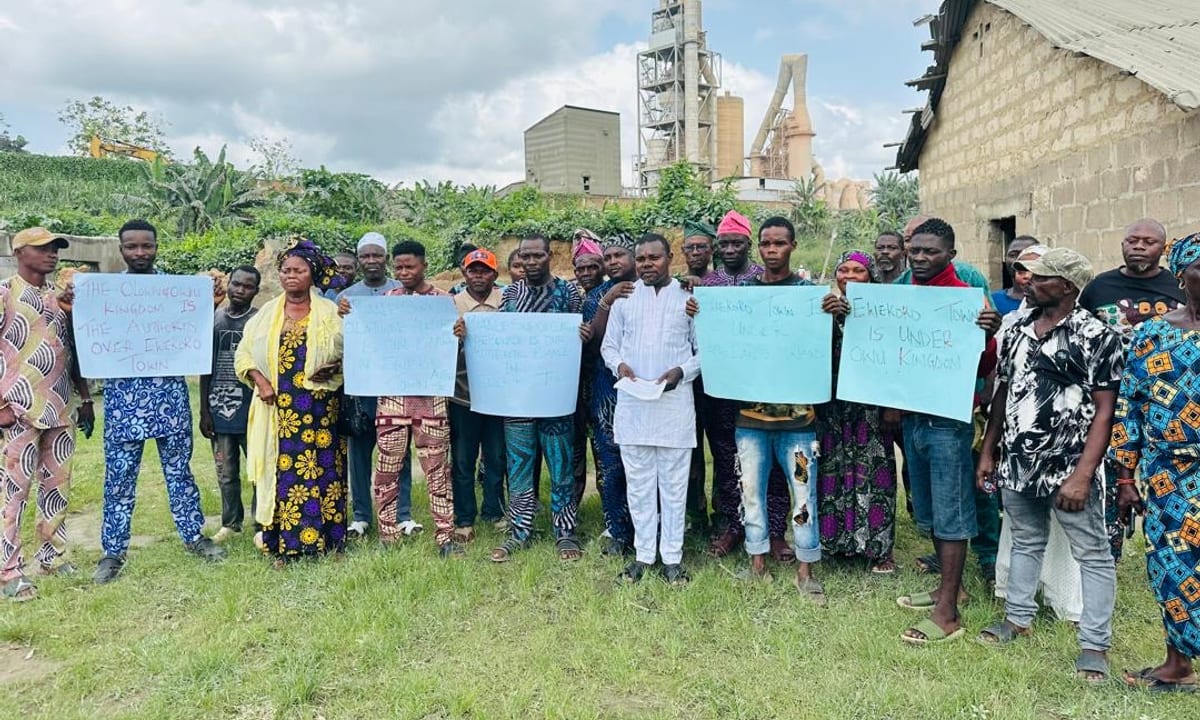
Residents of Ewekoro Town in Ewekoro Local Government Area of Ogun State have distanced themselves from a protest staged at the entrance of H.B.M. Nigeria Plc, formerly Lafarge Africa Plc, urging Governor Dapo Abiodun and security agencies to intervene to prevent further tensions.
The residents, including women and youths, staged a counter-rally on Friday, displaying placards affirming their community’s administrative and traditional affiliations.
Some of the inscriptions read, “Baale Suraju Olatunde Adebowale is our Baale in Ewekoro Town” and “The Olowu of Owu Kingdom is the authority over Ewekoro Town.”
Speaking on behalf of the community, Adebowale Adeola Abdulrahmon said the residents neither participated in nor authorised the July 21 protest that blocked the company’s entrance. He also disowned any court action allegedly instituted against the company on their behalf.
“We are not part of it, we didn’t authorise it,” Abdulrahmon said, calling on the state government and police to intervene and prevent the dispute from escalating.
He maintained that Ewekoro Town had historically been part of Papalanto Ward and was under the traditional authority of the Olowu of Owu Kingdom.
Abdulrahmon also dismissed allegations that Oba Saka Matemilola, the Olowu of Owu Kingdom, was withholding community funds from H.B.M. Nigeria, describing the claims as false and baseless.
He urged the government to address the dispute and ensure that those responsible for the earlier protest were called to account, arguing that their actions did not represent the community’s position.
“If the police is going to intervene on this matter, they should try as much as possible to help us to invite them, so that we should be able to tell them we are not in support of what they just did or demonstrated of recent,” he said.
The residents also disowned an individual allegedly parading himself as an Olori-Odo, insisting that he did not represent their position on the dispute. They called on the relevant authorities to clarify the issues surrounding the protest and the community’s relationship with the company.