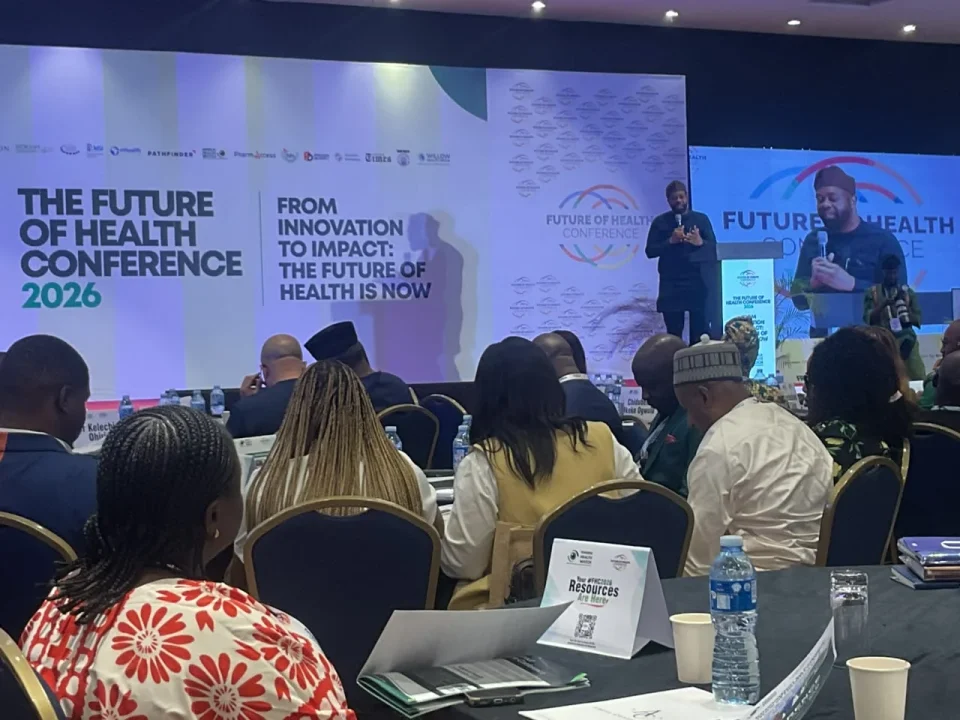
The Director-General of the National Health Insurance Authority (NHIA), Dr Kelechi Ohiri, says healthcare innovations must deliver measurable improvements in Nigerians’ lives, stressing that policies and technology alone cannot solve the country’s health challenges without effective implementation.
Ohiri spoke on Thursday at the 2026 Future of Health Conference, organised by Nigeria Health Watch in Abuja, where he highlighted interventions aimed at improving access to emergency maternal care.
He disclosed that about 19,000 women had benefited from the NHIA’s emergency obstetric care programme in the past 18 months, while approximately 300 hospitals had been accredited to provide services under the initiative.
The programme enables women experiencing childbirth complications to receive treatment without upfront payments, with the NHIA covering the cost of care. It is designed to prevent avoidable deaths caused by delays in accessing emergency medical attention.
“One of the most inequitable moments in the healthcare journey is when complications arise,” Ohiri said, referring to cases in which women in labour must wait for relatives to raise money before receiving urgent treatment.
He added that about 6,000 women had benefited from treatment for obstetric fistula through a separate intervention supported by the authority and its partners.
Ohiri said the programmes demonstrated how changes in healthcare financing could remove barriers to treatment, particularly for vulnerable groups.
“Our success will not be measured by the number of speeches we deliver or the policies we announce. It will be measured by real improvements in people’s lives,” he said.
He also called for greater domestic ownership of Nigeria’s health priorities, warning that changes in global health financing had exposed the risks of depending heavily on external funding.
Ohiri said the Nigerian Health Sector Reform Investment Initiative was built around four pillars: governance, service delivery, health financing and health security. The framework aims to improve coordination, expand access to care, address funding gaps and strengthen preparedness for public health emergencies.
He further disclosed that the NHIA was working with some state governments to integrate healthcare services into insurance schemes, with about 70,000 people enrolled through the approach.
On research and innovation, Ohiri said the authority had partnered with Nigeria Health Watch to support five independent researchers selected through a competitive process. He also announced the establishment of a health technology assessment committee to evaluate medicines, technologies and other interventions before decisions on their adoption and funding.
He said the NHIA was also introducing a balanced scorecard to assess primary healthcare facilities based on governance, community participation, clinical quality, data management and financial accountability.
Earlier, Nigeria Health Watch Managing Director Vivianne Ihekweazu said the conference, launched in 2016, had provided a platform for discussions on universal health coverage, healthcare financing, technology and private-sector participation.
At a panel session, Dr Erasmus Morah, a senior adviser to the Director-General of the Africa Centres for Disease Control and Prevention, said scientific advances alone could not improve health outcomes without political commitment and community participation.
Citing Nigeria’s HIV response, Morah said treatment coverage had risen from about 33 per cent in 2017 to approximately 85 to 86 per cent, partly following improvements in estimates of the number of people living with HIV.
“Innovation by itself will not move the needle. We need science, we need politics, and we need the community in between,” he said.
Molecular geneticist Dr Ify Aniebo highlighted the use of genomic research, artificial intelligence and machine learning to monitor malaria parasite drug resistance. She said her team had reduced the cost of sequencing a malaria parasite sample from about $150 to $20 and developed digital tools to make research findings more accessible to policymakers.
Meanwhile, Ikechukwu Anoke of Zuri Health called for increased investment in African-led innovations, including technology-enabled healthcare and community-based screening to expand access to services in underserved areas.
The conference brought together health sector officials, researchers, innovators and development partners to discuss how locally developed solutions could be funded and expanded to improve healthcare delivery in Nigeria.